

Trampoline guide
Rebounder vs trampoline what's the difference?
A rebounder is a small fitness trampoline for indoor workouts. A backyard trampoline is a big, netted play trampoline for kids. Here's how they compare, and which one you need.

Quick answer
A rebounder is a small fitness trampoline, about 1 metre wide, used indoors by one adult for low-impact cardio. Your feet barely leave the mat. A backyard trampoline is 1.8 to 4.9 metres wide, sits outdoors with a safety net, and is built for kids' play and big bounces.
A rebounder and a fitness “mini trampoline” are the same thing. A toddler mini trampoline is different: it's built for little kids, with a net or handle.
Rebounder vs trampoline: side-by-side
| Rebounder | Backyard trampoline | |
|---|---|---|
| Size | About 0.9 to 1.3 m across | 6 to 16ft (1.83 to 4.88 m) round, or rectangle and oval |
| Where it goes | Indoors, or a small patio | Outdoors on level grass, with 2 m clearance |
| Bounce | Low and controlled; feet stay close to the mat | High, springy bounce |
| Built for | Fitness and low-impact cardio workouts | Kids' play, games and tricks |
| Who uses it | One adult or teen | Kids and teens, one jumper at a time |
| Bounce system | Bungee cords or small springs | Steel coil springs, or springless elastic bands |
| Safety | Often a stability handle bar; no net | Full safety net enclosure and padded frame |
| Storage | Often folds and slides under a bed | Stays set up in the yard |
What is a rebounder?
A rebounder is a small, sturdy trampoline designed for exercise. Instead of jumping high, you do controlled movements: gentle bouncing, jogging on the spot, jumping jacks and twists. The mat absorbs much of the impact, which is why rebounding is popular as a low-impact cardio workout at home.
Most rebounders use bungee cords or short springs, stand on short legs close to the floor, and many have a handle bar for balance. They're made for one adult at a time, not for kids' play.
Is rebounding the same as jumping on a trampoline?
It's the same basic movement, but rebounding is a controlled, low bounce done as a workout, usually to music or a routine. Jumping on a backyard trampoline is higher, freer and more about play.
Is a mini trampoline the same as a rebounder?
Usually, yes“Mini trampoline”, “fitness trampoline” and “rebounder” are mostly used for the same thing: a small exercise trampoline for adults.
The exception is a toddler mini trampoline. It's similar in size but built for little kids, with a safety net enclosure, padded frame and a gentle bounce. It's for play, not workouts.
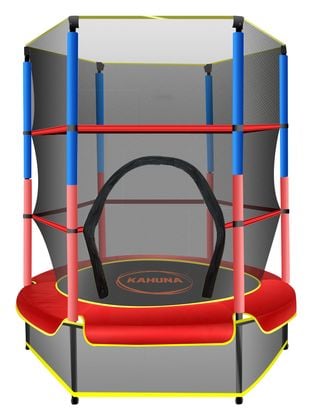
Kahuna 4.5ft Mini Trampoline
A toddler trampoline, not a rebounder: 1.37 m wide with a full safety net, for kids around 3 to 5 years. Max user weight 45 kg.
Fitness rebounder
About 1 m wide, low to the floor, with a stability bar and no net. Designed for an adult's controlled workout, not for young children to play on.
Kahuna doesn't sell fitness rebounders. Our range is built for kids' play, from toddler trampolines up to 16ft backyard trampolines.
Should I buy a rebounder or a trampoline?
- For your own workouts in a small space or indoors: a fitness rebounder.
- For toddlers (about 3 to 5): a toddler trampoline with a net, like the 4.5ft mini.
- For kids and teens to play outside: a backyard trampoline with a net. Most families choose 8ft to 12ft. See the trampoline size guide, and compare round vs rectangle trampolines.
- Want a softer bounce with no springs? Compare spring vs springless trampolines.
One jumper at a time on any trampoline or rebounder. Supervise young children, and keep backyard trampolines on level ground with 2 m of clear space around them.
Rebounder and trampoline FAQs
What's the difference between a rebounder and a trampoline?
A rebounder is a small (about 1 m) fitness trampoline for controlled, low-bounce indoor workouts by one adult. A backyard trampoline is 1.8 to 4.9 m wide, goes outside with a safety net, and is built for kids' play and higher bounces.
Is a rebounder the same as a mini trampoline?
Usually, yes. Fitness “mini trampolines” and rebounders are the same product. Toddler mini trampolines are different: they have a net and are built for young children's play.
Can kids use a rebounder?
Rebounders are designed for adult exercise and usually have no net, so they aren't made for young children to play on. For kids, choose a toddler trampoline or a backyard trampoline with a safety enclosure.
Can you use a rebounder outside?
You can use one on a flat, sheltered surface, but most are built for indoor use. Don't leave one out in the weather.
Is rebounding better exercise than a big trampoline?
A rebounder is made for structured workouts, with a lower, more controlled bounce. A backyard trampoline is more about play, though kids still get plenty of exercise on one.
Looking for a trampoline the kids will love?
From 4.5ft toddler trampolines to 16ft backyard trampolines, all with safety nets and shipped Australia-wide from Melbourne.